What happened on the board while you weren't looking.
Every day, every project gets a short briefing: what changed, what needs attention, and what's at risk. It's waiting at the top of the backlog when you sit down.
Nobody has to sign in for it to run. Nobody has to remember to write it. And nobody has to trust it blindly, because the facts it was written from are right underneath it.
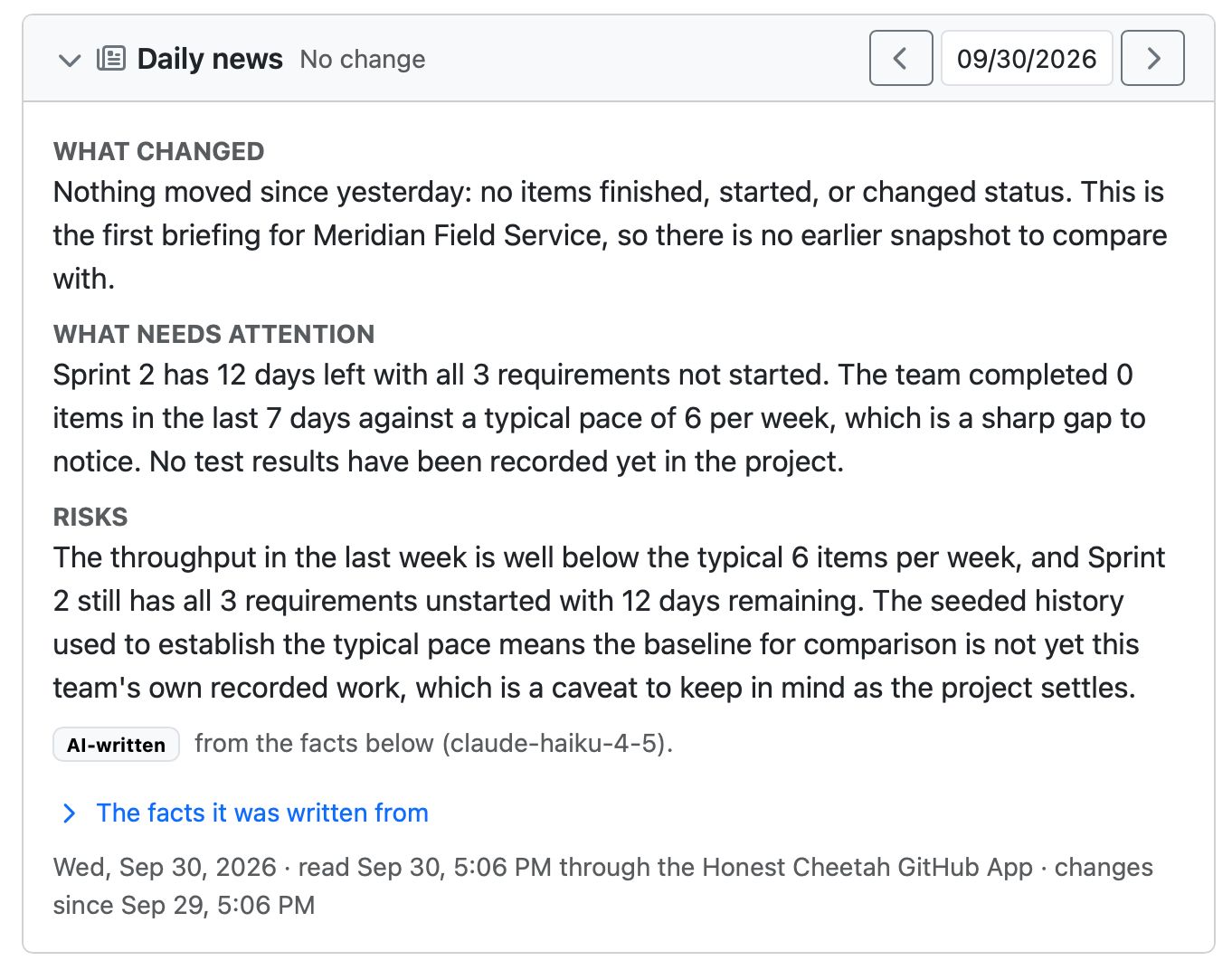
Three sections, every day
What changed
What moved to Done, what got started, what moved back, and what was added since the last read. Each requirement counts once, no matter how many times it bounced.
What needs attention
Work that's aging, the current iteration's days left against what hasn't started, and the QA picture: results recorded, bugs filed, and requirements that went Done without a passing test.
Risks
The last seven days' throughput against your typical week, and how many weeks of history that "typical" rests on. If the history is seeded or imported, it says that too.
The code counts. The AI writes it up.
Every number in the briefing is computed by deterministic code before the AI sees anything: the moves, the ages, the throughput, the days left. The model's job is to turn those facts into a few readable sentences. It's told not to compute new numbers, not to guess at causes, and to repeat every caveat it's given.
Then it's checked. If the write-up mentions an issue that isn't in the facts, the whole write-up is thrown away and you get the facts on their own. A briefing that invents an item is worse than no briefing.
- The write-up is badged AI-written, with the model that wrote it.
- The facts it was written from is one click away, with links to each item in HC and on GitHub.
- Counts, not percentages. Same rule as the rest of the product.
"Since yesterday" means since yesterday
Each day's facts are kept. "What changed" is the difference between today's read and the last one, not a guess from GitHub's activity feed. Use the date picker on the card to go back a day, or a month. Briefings are kept for a year.
When nothing moved, the card says No change and doesn't bother the AI. A day passing isn't news.
Read by the GitHub App, not by you
The briefing is read through the Honest Cheetah GitHub App installed on your organization, not through anyone's personal account. It keeps working when people go on holiday or leave the company, and it doesn't spend anyone's GitHub rate limit. The card's footer says exactly when it was read and what window it covers.
Install the App early. History starts the night it's installed, and nobody can backfill it. Org owners see an Install the GitHub App button on the card; everyone else gets told who to ask.
Who sees it, and what it costs
- Anyone with an HC seat who can open the project on GitHub sees its briefing.
- Every project you've set up in HC gets one. No "favorites only," no per-project switch to remember.
- It runs on your organization's monthly AI budget. A quiet project costs nothing, because no change means no AI call. If the budget runs out, you still get the facts, and the card says why.
- It doesn't email you, post to Slack, or write anything to GitHub. It's on the backlog page, and that's where it stays.
Five people, 15 days, the whole product
Daily news is included, same as everything else. Sign in with GitHub, install the App, and tomorrow there's a briefing waiting. Then it's per seat.